Masdevallia Veitchiana Records Cluster at Machu Picchu, and One Sits at 3,105 Metres
Pull the 241 GBIF records for Masdevallia veitchiana and 213 of them are in Peru. Plot the Peruvian ones and they land almost on top of each other, around 13.16 degrees south and 72.54 west, which is the ridge at Machu Picchu. Several were logged by tourists walking the circuit.
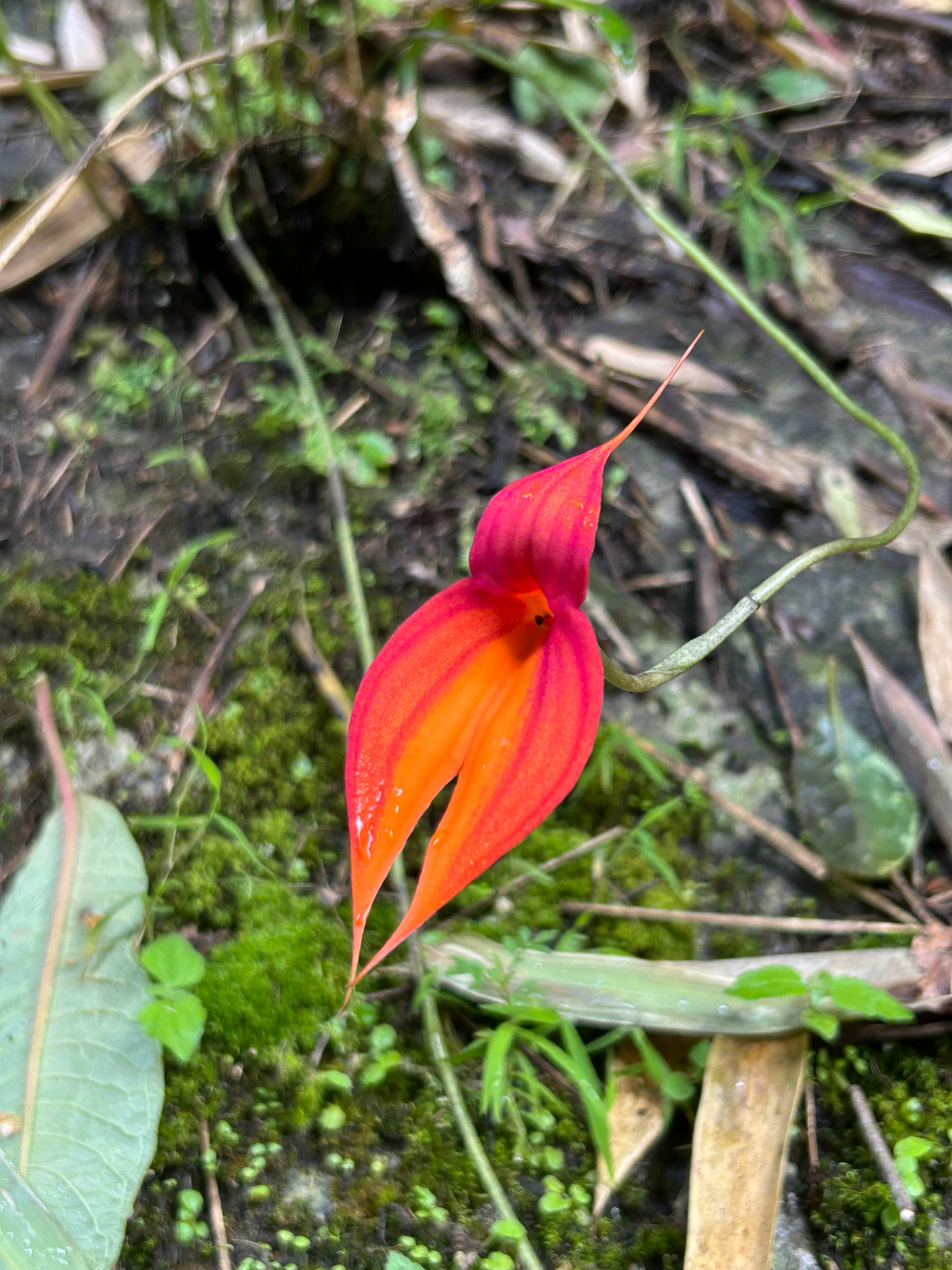
Photo: Allan Harris, via GBIF (CC0)
That concentration is partly real and partly an artefact of who carries a phone up a mountain. The species runs more widely through the Cusco department than the map suggests. But the habitat type is consistent wherever it turns up, and one record settles what that habitat is.
The Number That Matters
Most of these records carry no elevation at all. Of 241, only twelve have an altitude attached, which is a limitation worth knowing before anyone tries to build a climate profile from this dataset.
One of the twelve is a herbarium specimen collected in Peru in October 1987 by Percy Núñez and J. Arque, held at Missouri Botanical Garden. Its elevation reads 3,105 metres.
Three thousand one hundred metres is high. For comparison, that is above the tree line in much of the temperate world and roughly the altitude of a mid-sized Alpine pass. The orchid is growing in cloud forest and scrub on steep ground where the air is thin, the nights are genuinely cold, and mist sits on the slope for much of the day.
That single verified figure tells you more about growing this plant than a shelf of general advice about masdevallias.
Cold, Wet, and Moving Air
The culture follows directly.
Nights need to be cold. Aim for 10 to 13°C and do not be nervous about the low end. Growers who keep this species in a warm collection get weak growth and no flowers, and summer heat is the usual killer. Sustained days above about 24°C put the plant under real stress.
Humidity high, with constant air movement to go with it. Stagnant damp at cool temperatures rots masdevallias fast, so a fan matters as much as the misting does.
Never let the roots dry out. There is no dry rest in this plant’s year. Water quality matters too, because Masdevallia is intolerant of accumulated salts, and rainwater or reverse osmosis is worth the trouble if your tap supply is hard.
Small pots, fine open medium, and repotting more often than you would for a cattleya, since stale medium at these temperatures goes sour.
The flower is the reason people persist. Large for the genus, vivid orange, and covered in tiny purple hairs that catch the light and shift the colour as you move past it.
The Name Is a Nursery
Veitchiana is not a place or a botanist. It honours James Veitch and Sons of Chelsea, the largest commercial orchid nursery in Victorian Britain, who had the plant collected and brought back in the 1860s. Reichenbach described it from their material.
That is the shape of a lot of Andean orchid history. The plants reached science through the trade rather than the other way round, because the nurseries were the ones funding collectors into the mountains. Veitch employed Richard Pearce to work Peru and Chile, and species after species entered the literature already carrying a commercial name.
It is worth remembering when reading an occurrence map. The record trail for these plants starts with people who were selling them.
What the Map Does Not Show
Two hundred and thirteen Peruvian records sounds healthy until you notice how few distinct sites they represent. A famous, heavily walked archaeological site with an orchid growing beside the path generates a lot of observations from one population.
The species is not assessed as secure, and habitat along the accessible ridges has been under pressure for decades from collection and from tourism itself. The data is dense exactly where people go, and thin everywhere else in the department.
Grow it cold, keep it wet, and buy it from a nursery that flasks its own.