Mexico Has More Wild Vanilla Records Than Madagascar, Which Grows Most of the Crop
There are 626 GBIF records for Vanilla planifolia, which is a startlingly small number for the second most expensive spice in the world. Mexico leads with 100. The United States has 52, almost all of them Hawaii and Florida. Réunion has 43, Madagascar 39, Guadeloupe 33, Costa Rica 30, the Seychelles 25.
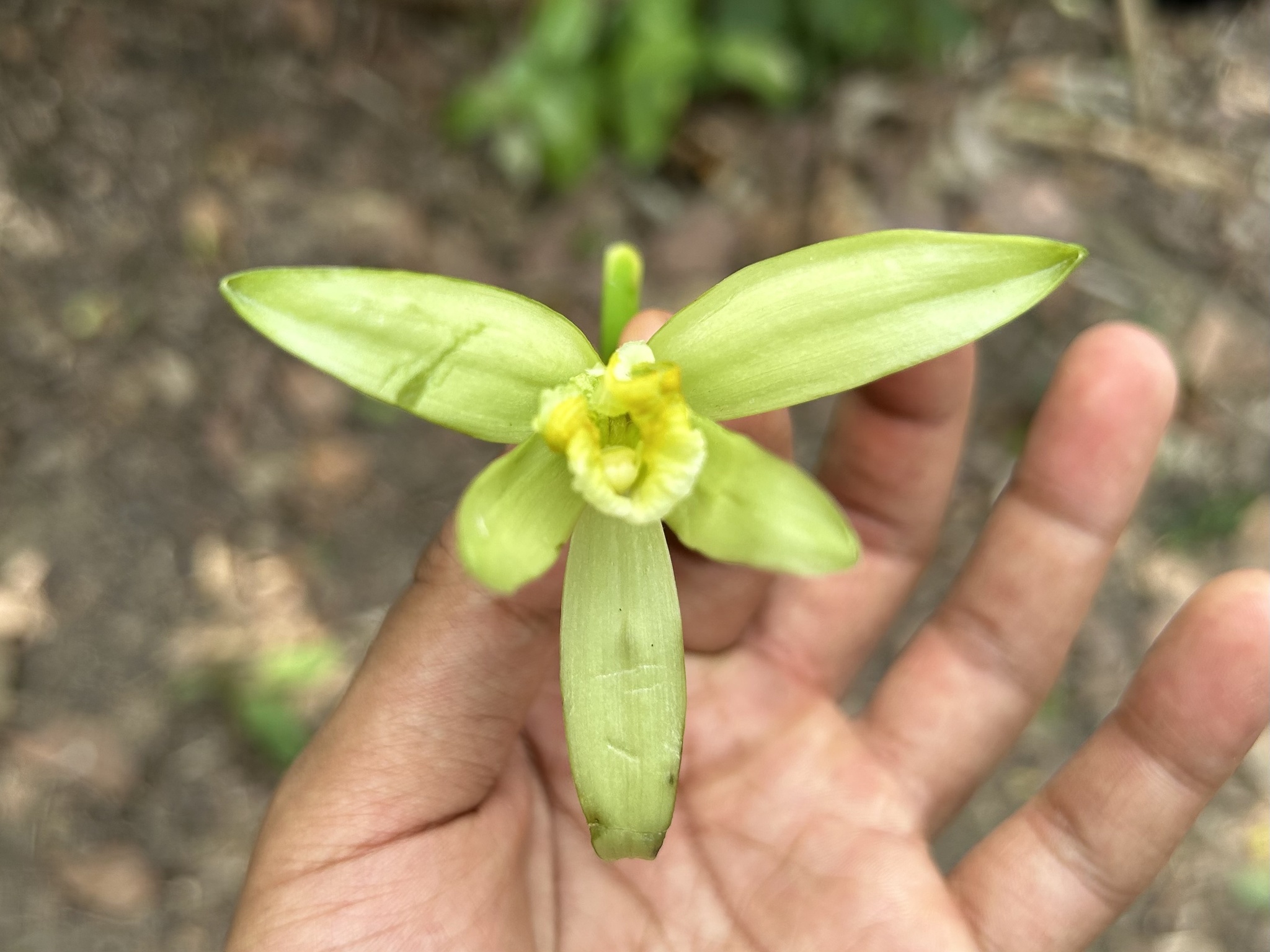
Photo: marcodiazz, via GBIF (CC0)
Madagascar grows a large share of the world’s vanilla and appears in this list below Réunion, a far smaller island. That inversion is the whole history of the crop in one column of numbers.
The Records Are Mostly Not Wild Plants
Read the country list again and notice what it is. Réunion, the Seychelles, French Polynesia, Guadeloupe, Martinique, Indonesia. None of these are in the native range. Vanilla planifolia is Mesoamerican, from the humid lowland forests of eastern Mexico through into Central America, and everything east of the Atlantic on that list is a plantation escape or a botanical collection.
Genuinely wild populations are scarce. The species is assessed as Endangered in its native range, where habitat clearance has taken most of the forest it grew in, and where the remaining wild genetic diversity is thin because the global crop descends from a very small founding stock.
So the map is not showing you where vanilla lives. It is showing you where people carried it, which turns out to be the more interesting map.
Why Réunion Is on the List Twice Over
Vanilla left Mexico early and refused to fruit. Plants grew perfectly well in colonial greenhouses and plantations across the tropics and set almost no pods, because the pollinator had stayed behind. The flower’s anther and stigma are separated by a flap of tissue, and without an insect that lifts it, nothing happens. The flower opens for less than a day and closes unfertilised.
The fix came from Réunion in 1841, from an enslaved boy named Edmond Albius, who was about twelve. He worked out that the flap could be lifted with a sliver of bamboo and the pollen pressed onto the stigma with a thumb. The technique spread across the Indian Ocean, and every vanilla pod produced commercially today, in Madagascar and everywhere else, is made by hand using essentially his method.
Forty-three records on Réunion, and the reason the crop exists at industrial scale anywhere.
Growing It
Vanilla is a vine, and that is the thing most people underestimate. It climbs, it does not stay put, and a plant confined to a small pot with a moss pole will sulk for years. Give it something substantial to run along, horizontally as well as up, because flowering tends to come once the vine has length behind it.
Warm and humid, in the 25 to 30°C range, with the humidity to match. It is a lowland tropical plant and it will not tolerate cold.
Bright shade rather than full sun. In cultivation it is usually grown up a support tree that provides filtered light.
Coarse, open medium with plenty of air, and aerial roots left free rather than buried.
Then patience, because a vine typically needs three years or more and considerable size before it flowers at all. When it does, the flowers open in the morning and are finished by afternoon, so pollination is a daily job during the season. A pod takes eight to nine months to mature on the vine, and the cured product needs months more of sweating and drying before it smells of anything.
That chain explains the price better than any market commentary. Hand pollination on a one-morning window, nine months to the pod, months again to cure.
Worth Knowing Before You Buy One
Most vanilla plants sold to hobbyists are V. planifolia, and most will never fruit indoors, because they never reach the size. Growing it as a foliage vine is a perfectly good reason to own one. Growing it for pods needs a greenhouse, a long support, and the willingness to check flowers every morning for weeks.
The 626 records are a small number because almost nobody is finding this plant in the wild any more. The crop is everywhere. The species is not.