Why Orchids Steal the Show, and Why It Is Always the Same Few Orchids
A florist’s window in Poland, the board behind it advertising seasonal work and funeral arrangements. There is plenty in the frame: anthuriums, garden roses, peonies, chrysanthemums, tulips at the bottom, statice off to the right. None of it registers. The cream Phalaenopsis spray comes forward and turns everything else into background.
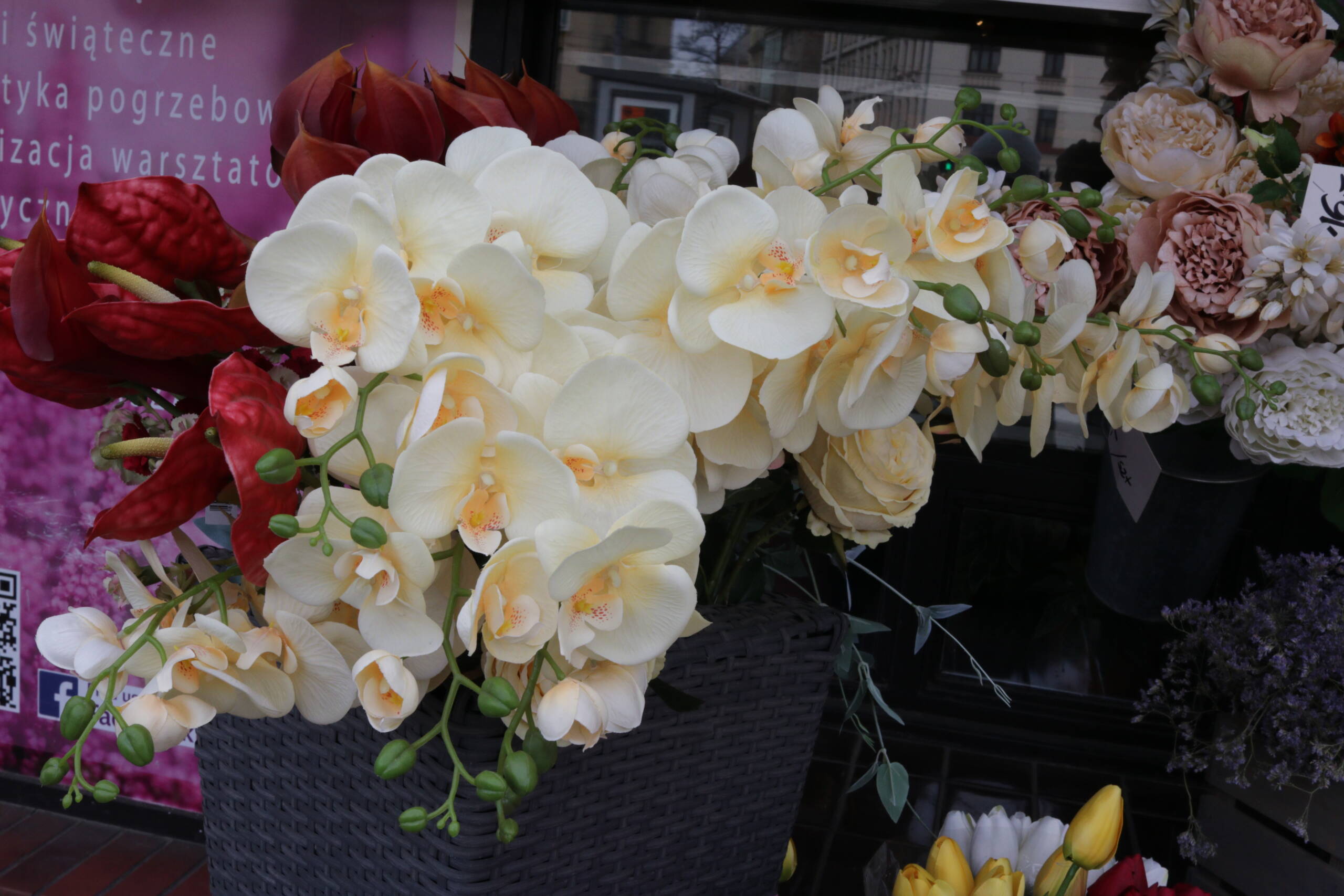
Growers know the effect without needing it explained. It is worth pulling apart anyway, because the reasons are structural rather than aesthetic, and because they explain the odd shape of the trade that has grown up around this genus.
Bilateral symmetry is a face
Nearly everything else in that window is radially symmetric. A rose, a chrysanthemum, a tulip all look the same rotated around the axis, which gives the eye no orientation to hold on to.
Orchids are zygomorphic. One mirror plane, an up and a down, a left and a right. Two lateral petals reading as wings, a labellum sitting below as a lower lip, a column in the middle where the andraecium and gynoecium are fused into one organ. The human visual system runs a face detector continuously and cheaply, and this geometry trips it. Attention lands on the orchid before anyone chooses to look at it.
The resupination underneath is the part that still seems slightly improbable when you watch it happen. The pedicel and ovary rotate through 180 degrees as the bud opens, carrying the labellum from the top of the flower to the bottom so it presents as a platform. The face is assembled inverted and then turned over.
The flowers are waiting, not performing
Pollinia are the reason an orchid never sheds onto a windowsill, never stains a cloth, never needs the vase moved off good furniture. Loose powdery pollen persists only in the apostasioids; everywhere else the grains are bound into packets and handed over whole. Florists get a flower that behaves itself for weeks.
The cost is specificity. Fit your reproduction to one visitor and most flowers never receive it, so the plant holds the display open and keeps waiting. A Phalaenopsis bloom will stand for two or three months on that basis.
Effect pollination on it and the flower is finished in days, the ethylene response collapsing what the plant had been maintaining. Every long-lived display is a record of nothing having arrived.
The inflorescence has already done the arranging
The last advantage is compositional. Flowers sit along an arching raceme, opening from the base upward, largest and oldest at the bottom, tapering into buds at the tip.
That is a finished arrangement on a single stem: a diagonal, a rhythm, a focal point, a gradient of scale. A florist building the same effect out of roses is cutting a dozen stems to different lengths and wiring them into position. The orchid supplies it whole, so it goes at the front of the display, which is where the eye was heading anyway.
The narrow end of a very wide family
Here is the part worth sitting with. Orchidaceae runs to something like 28,000 species, one of the two largest families of flowering plants on earth. The show is being stolen, in that window and in most windows, by a handful of white and cream Phalaenopsis hybrids.
They won on production economics as much as on looks. They flask reliably, they clone true through meristem culture, they ship without damage, they tolerate a heated flat with poor light and no humidity, they rebloom for an owner who does nothing correct. Very little else in the family will accept those conditions, so very little else gets to the shop.
The result is a public that recognises one silhouette and calls it an orchid. Anyone who keeps them knows how strange that is, given what the family actually contains.
Worth remembering next time one of these stops a person in the street. It is doing the job for the other twenty-eight thousand.