Mini Orchids: A Complete Guide to Growing, Understanding, and Appreciating Miniature Phalaenopsis
There is something quietly compelling about a plant that delivers the full drama of a tropical bloom in a footprint the size of a coffee cup. Mini orchids — compact cultivars of the ever-popular Phalaenopsis genus — have become one of the most sought-after houseplants of the past two decades, and for good reason. They bloom prolifically, last for months, and ask relatively little in return. But beneath that commercial appeal lies a genuinely fascinating story of natural adaptation, deliberate breeding, and horticultural ingenuity.
This guide covers everything you need to know: what mini orchids are, where they come from, why they are small, how to care for them, and what to do when things go wrong.
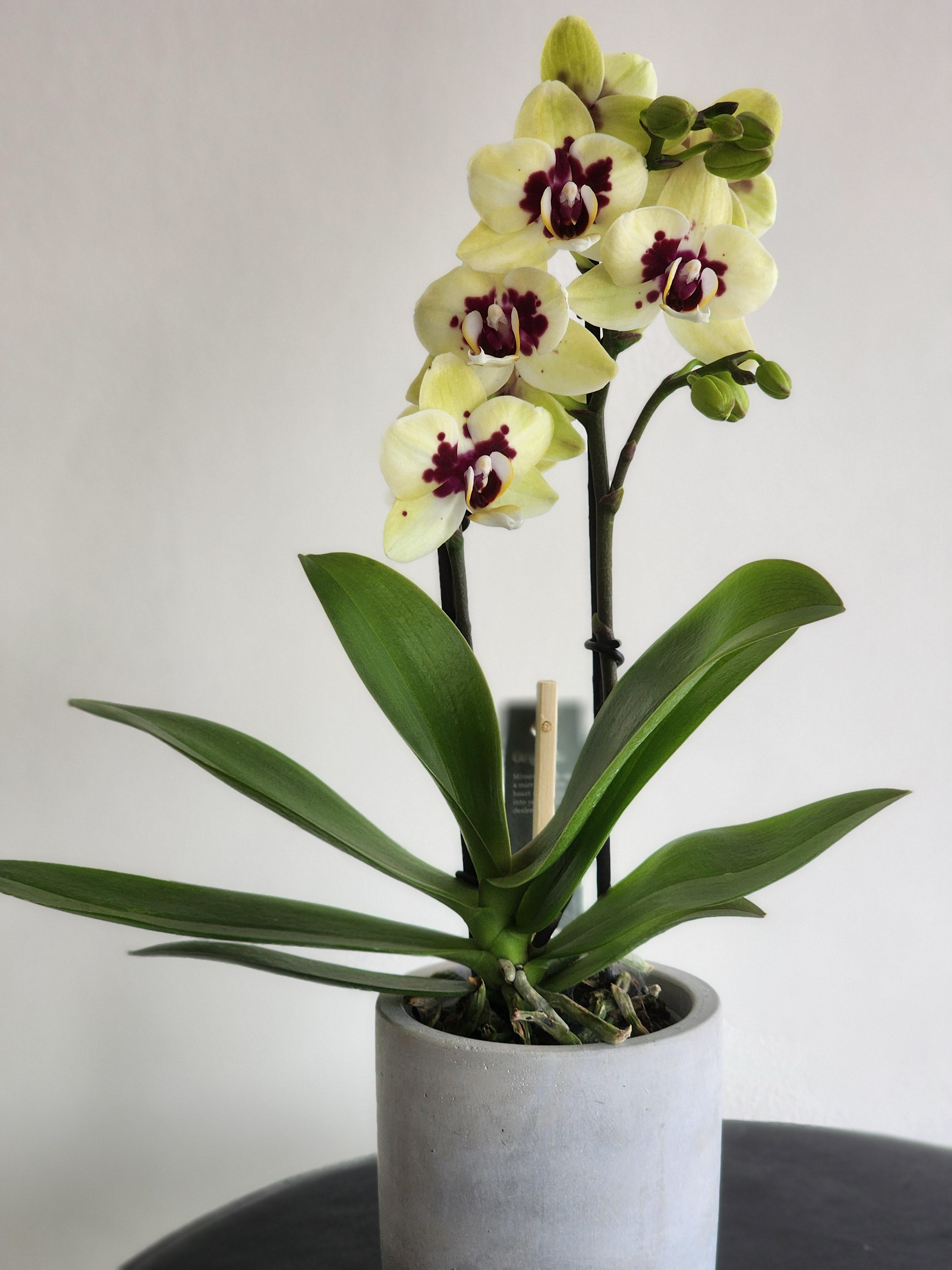
Featured plant: miniature Phalaenopsis hybrid, two-spike specimen in concrete pot.
What Are Mini Orchids?
The term “mini orchid” most commonly refers to miniature cultivars of Phalaenopsis, the moth orchid — the most widely grown orchid genus in the world. Standard Phalaenopsis plants typically reach 45–60 cm in height when in bloom. Mini Phals, as they are commonly called, stay under 20 cm, with proportionally smaller leaves, shorter spikes, and flowers that are smaller in absolute terms but often appear denser and more abundant relative to plant size.
The plant pictured above is a textbook example: two upright spikes bearing pale yellow-green blooms with a striking deep burgundy lip, set against broad, dark green leaves, all contained in a compact concrete pot. Several buds remain unopened on the right spike — a sign of good health and weeks of blooming still ahead.
It is worth being precise: “mini orchid” is a commercial and horticultural descriptor, not a taxonomic one. These are not a separate species. They are hybrid cultivars — the result of selective breeding programs that locked in compact genetics while maximising flower impact.
The Natural Origins of Small Phalaenopsis
To understand why mini orchids exist, you need to understand where Phalaenopsis comes from.
The genus is native to a broad swath of tropical Asia, from the Indian subcontinent through Southeast Asia, the Philippines, and into southern China and northern Australia. Most species grow as epiphytes — plants that live on trees rather than in the ground, anchoring their roots to bark and drawing moisture and nutrients from the air, rain, and organic debris that accumulates around them.
Epiphytic life imposes real constraints. Resources are limited. Competition for light is intense. Many branches and forks where orchids take hold are genuinely small microhabitats — exposed, variable in moisture, and able to support only a small plant mass. Natural selection rewarded plants that could thrive in those conditions, which meant compact growth habits, efficient root systems, and the ability to redirect energy into flowers rather than vegetative bulk.
Several Phalaenopsis species are naturally compact:
- Phalaenopsis equestris — native to the Philippines and Taiwan, rarely exceeds 15 cm in leaf span. One of the most important progenitors of modern mini hybrids.
- Phalaenopsis stuartiana — another Philippine species, known for its branching spike habit and relatively small stature.
- Phalaenopsis lindenii — a delicate, compact species from Luzon with pale lavender markings.
- Phalaenopsis parishii — one of the smallest in the genus, found in Myanmar and northeastern India, with flowers barely 2 cm across.
These species were not anomalies. They were simply the natural result of their environments.
Why Mini Orchids Are Mini: The Genetics
The compactness of mini Phalaenopsis hybrids is not a mutation, a defect, or a form of dwarfism in any pathological sense. It is the expression of a stable genetic program.
Plants produce their size through two mechanisms: cell division (how many cells form) and cell elongation (how large those cells grow). In compact Phalaenopsis species, both are restrained — fewer cell divisions per organ, and shorter elongation at each internode (the stem segment between leaf attachment points). The result is proportionally correct anatomy, just compressed.
When breeders cross a compact species like P. equestris with a larger hybrid, they can select offspring that inherit the short internode spacing and reduced leaf size while also inheriting the larger, more showy flowers from the other parent. Over multiple generations of selection, these traits can be stabilised into a reliable compact habit.
This is why most commercial mini Phals you encounter today are several generations removed from their wild ancestors. The genome has been refined and refined again — always selecting for the visual payoff of a large flower on a small plant.
The Breeding Story: From Field to Windowsill
The commercialisation of mini Phalaenopsis is largely a story of Taiwanese and Dutch orchid breeding industries, which have dominated global orchid production since the 1980s.
Taiwan in particular possesses a climate that allows year-round outdoor cultivation and a long history of horticultural expertise. Breeders there began producing Phalaenopsis hybrids at industrial scale, and the demand for apartment-friendly, compact varieties emerged naturally as urban living expanded. A plant that fits on a windowsill, blooms for three months, and can be sold for a modest price point was a commercially powerful concept.
The development of clonal propagation via tissue culture (meristemming) in the 1970s and 1980s transformed the industry. A single exceptional hybrid could be propagated into millions of genetically identical plants, making it possible to guarantee consistent flower colour, form, and size at retail scale. Every mini orchid you see at a garden centre or supermarket is almost certainly a tissue-culture clone of a proven commercial hybrid.
What breeders optimised for, beyond size, included:
- Spike count — two or more spikes per plant, as in the example above, became a standard expectation in premium cultivars.
- Bud count per spike — more buds means longer display duration as buds open sequentially.
- Flower longevity — individual blooms that hold colour and form for 6–10 weeks.
- Root vigour — compact plants with aggressive, healthy root systems that tolerate the commercial supply chain (weeks in boxes, variable temperatures, inconsistent watering).
- Colour range — from pure white and blush pink through yellow, green, deep magenta, striped, and spotted patterns. The burgundy lip pattern on the plant pictured — where the labellum carries saturated pigmentation against pale petals — is a particularly sought-after trait achieved through deliberate hybrid crosses.
Anatomy of a Mini Phalaenopsis
Understanding the plant’s structure helps with both appreciation and care.
Leaves are thick, succulent, and waxy — adaptations to their epiphytic origins that allow them to store water and tolerate short dry periods. In healthy plants, leaves are deep green, firm, and slightly glossy. Yellowing, limpness, or spotting are diagnostic signals worth paying attention to.
Roots are silvery-grey when dry and turn bright green when hydrated. They are covered in a spongy tissue called velamen that rapidly absorbs water and then acts as a moisture buffer. Healthy roots are firm and uniformly coloured. Black, mushy roots indicate rot; desiccated, papery roots suggest chronic underwatering.
The spike (or inflorescence) emerges from between the leaves and extends upward, bearing multiple buds that open sequentially from the bottom of the spike upward. In mini hybrids, spikes are proportionally shorter but often carry a higher bud density than standard Phals.
The flower consists of three sepals (outer whorl) and three petals (inner whorl), one of which — the labellum or lip — is morphologically distinct from the other two. In wild Phalaenopsis, the lip evolved to guide pollinators (primarily large bees in some species, moths in others) toward the pollen masses. In cultivated hybrids, breeders have manipulated the lip’s size, shape, and colour for ornamental effect. The deep burgundy lip on the pictured plant is an amplified version of a natural pigmentation pattern.
Bloom Duration and the Flowering Cycle
One of the primary reasons mini Phalaenopsis became commercially dominant is their extraordinary bloom longevity.
Individual flowers, once open, typically hold for 4–8 weeks depending on ambient temperature and humidity. Since buds open sequentially over 2–4 weeks, a spike with eight buds may be in active bloom for 3–4 months continuously. A plant with two spikes, like the one pictured, can deliver close to six months of bloom in a good season.
After blooms drop, the plant enters a rest and recovery phase. This is not failure — it is normal. The plant is redirecting energy from reproduction back to vegetative growth: building leaf mass, extending roots, accumulating the reserves needed for the next flowering cycle.
Inducing re-bloom requires a temperature differential. Phalaenopsis initiate flower spikes in response to cooler nights — typically 10–15°C for 4–6 weeks. In practice, positioning the plant near a window in autumn, where overnight temperatures drop naturally, is often sufficient. Avoid air conditioning vents, which can cause cold shock; the goal is gradual, moderate cooling.
Once a spike initiates, it will develop buds and bloom again over the following 8–12 weeks. Some growers cut the spike above the second or third node after first bloom rather than at the base — this can trigger a lateral branch from that node and produce a second, smaller flush of flowers without waiting for a full new spike. It is a useful technique for extending the display, though the resulting blooms are typically fewer and smaller.
Care Guide
Light
Mini Phalaenopsis require bright, indirect light. Direct sunlight, particularly through south- or west-facing glass in summer, will bleach and burn the leaves. A north or east-facing windowsill is often ideal in the northern hemisphere — good light without harsh direct sun.
A useful diagnostic: leaves should be medium to dark green. Pale, yellowish-green leaves suggest too much light; very dark, deep green with no new growth suggests too little. The plant will tell you if you pay attention.
Watering
This is where most failures occur. Phalaenopsis roots are adapted to the boom-and-bust moisture cycles of their epiphytic habitat — soaking rain followed by rapid drying. Chronic overwatering, which keeps roots perpetually wet, leads to anaerobic conditions and root rot.
Water thoroughly — enough to drench the medium and allow runoff — and then wait until the medium approaches dryness before watering again. In typical indoor conditions, this means roughly once every 7–10 days in summer, less frequently in winter.
The concrete pot in the image above is worth noting. Concrete is porous and allows evaporation through the pot walls, which slightly accelerates drying compared to a glazed ceramic or plastic pot. In a concrete pot, you may need to water slightly more frequently than the 10-day guideline — observe the roots through the medium and let them guide you.
Never allow water to pool in the crown (the centre, where leaves emerge). Stagnant water in the crown causes crown rot, which is rapidly fatal. If water accumulates there, blot it dry with a paper tissue.
Humidity and Air Circulation
Native Phalaenopsis habitats are humid — 60–80% relative humidity is typical. Most indoor environments run at 40–50%, which is tolerable but not optimal. A pebble tray with water placed beneath (but not touching) the pot increases local humidity. Grouping plants together achieves the same effect.
Air circulation matters too. Stagnant air promotes fungal disease. A gentle fan running nearby is beneficial, particularly in humid seasons.
Temperature
Mini Phals are comfortable in the range humans find comfortable: 18–28°C. They tolerate brief excursions outside this range but suffer if cold drafts are sustained. Keep them away from exterior doors in winter.
Feeding
A balanced, water-soluble orchid fertiliser at half the recommended concentration, applied every second or third watering during the growing season, is sufficient. Avoid feeding during dormancy or when the plant is stressed. The common guidance “weakly, weekly” — a dilute solution applied frequently — reflects the plant’s preference for steady, low-level nutrition over occasional heavy doses.
Potting Medium and Repotting
Commercial mini Phals are typically sold in fine bark chips or a bark-perlite blend. This medium degrades over time — bark breaks down, becomes compacted, and holds water excessively. Repot every 18–24 months, or sooner if you observe root crowding or medium deterioration.
When repotting, gently remove the old medium, trim any dead or rotted roots (clean cuts with sterile scissors), and pot into fresh bark medium in a container only slightly larger than the root mass. Going too large with the pot leaves excess wet medium around the roots — a common cause of rot.
Common Problems and Diagnosis
Yellow leaves: Most commonly caused by overwatering or excess direct light. A single lower leaf yellowing as the plant grows is normal (older leaves are shed progressively). Multiple yellowing leaves simultaneously warrants investigation.
Root rot: Black, mushy roots with an unpleasant odour. Caused by overwatering or poor drainage. Treatment: remove all affected roots, let the plant dry thoroughly, repot in fresh medium, and adjust watering practice.
Bud blast (buds dropping before opening): Typically caused by sudden temperature change, exposure to ethylene gas (ripening fruit nearby is a surprising and common culprit), or cold drafts. Stable conditions usually prevent this.
No re-bloom: Usually insufficient temperature differential during the induction period, or insufficient light. Moving the plant to a cooler spot with good indirect light in autumn is the standard intervention.
Scale and mealybugs: The two most common pests on indoor Phalaenopsis. Scale appears as small brown waxy bumps, often along leaf midribs and under leaves. Mealybugs are white, cottony. Both can be treated with isopropyl alcohol on a cotton swab for small infestations; systemic insecticide for larger ones. Quarantine any new plant for 2–3 weeks before placing it near your existing collection.
Why Mini Orchids Have Become a Cultural Phenomenon
The rise of mini Phalaenopsis parallels broader trends in urban living, interior design, and the popularisation of plant collecting over the past decade.
Their footprint fits the reality of contemporary life: apartments, studios, shared spaces, and crowded windowsills. They bloom with minimal specialist knowledge — someone who has never grown an orchid can achieve a three-month display on their first attempt. The price point, kept low by industrial tissue-culture production, makes them accessible as gifts, impulse purchases, and replaceable décor.
But there is also something more than mere convenience. The Phalaenopsis flower is genuinely beautiful — bilaterally symmetrical in a way that is almost architecturally satisfying, available in a colour range that spans nearly the full spectrum, and bearing that distinctive lip structure that hints at the evolutionary story beneath the ornamental surface.
A mini orchid on a desk or windowsill is, in a quiet way, a piece of tropical Asia adapted to your living room. The genetics that made Phalaenopsis equestris thrive on a branch in the Philippines are still there, expressed now in a compact hybrid bred to last through a winter on a concrete shelf in an apartment in Copenhagen or Seoul or Chicago.
Selecting a Healthy Mini Orchid
When buying, look for:
- Firm, dark green leaves with no yellowing, spotting, or limpness
- Visible roots that are silvery-grey (dry) or bright green (recently watered), not black or absent
- Multiple unopened buds — this extends the display significantly; a plant with all flowers open may only have days or weeks left on that spike
- Two or more spikes — a sign of good cultivation and strong root health
- No signs of pests — check under leaves and along the base of the spike
The plant pictured ticks all of these boxes. Two spikes, firm foliage, unopened buds still to come, roots visible and clean at the base of the pot. It is a plant in good health, well into its bloom cycle with more to offer.
A Note on Other Mini Orchid Genera
While mini Phalaenopsis dominate the commercial market, the broader world of miniature orchids is remarkably rich. Growers who develop a taste for the compact form often explore:
- Miniature Cattleya and Laelia hybrids — fragrant, intensely coloured
- Lepanthes and Stelis — tiny Colombian cloud forest species with intricate, jewel-like flowers barely millimetres across
- Masdevallia — cool-growing Andean species with triangular flowers and strong colour
- Oncidium alliance miniatures — including the famous dancing-lady flower form
- Dracula — extraordinary species with flowers that mimic the appearance of fungi, adapted to fool gnats into pollination
The genus Phalaenopsis is the entry point for most growers, but it is by no means the limit of what miniature orchid culture offers.
Final Thoughts
Mini orchids are often dismissed as supermarket flowers — disposable, replaceable, not “serious” horticulture. This is a mistake. They are the product of generations of skilled breeding, rooted in genuinely fascinating species with remarkable evolutionary histories, and capable of years of repeat blooming under attentive care.
The compact Phalaenopsis on your windowsill carries within it the genetics of plants that evolved to grip a tree branch in a Philippine forest. It has been refined, selected, cloned, and shipped across the world to end up on your shelf. It asks only for indirect light, careful watering, and a cool autumn window to trigger another season of flowers.
That seems like a reasonable trade.