What These Buds Tell an Orchid Grower
I’m looking at this image as a grower, not as a romantic, and what I see is a Phalaenopsis that has been handled correctly up to this point. The spike is mature, properly staked early, and carrying buds that are evenly spaced and progressing in size from the base upward. The buds are still closed but clearly defined, with visible seams and a firm, slightly matte surface, which tells me they’re hydrated and actively developing. The color—green with brownish and faint purple tones—is typical at this stage and means nothing in terms of final flower color. Importantly, there’s no wrinkling, yellowing, or uneven swelling, so there’s no sign of stress during spike formation. The gentle curve of the spike suggests it followed a stable light source and wasn’t constantly rotated, which is exactly what you want.
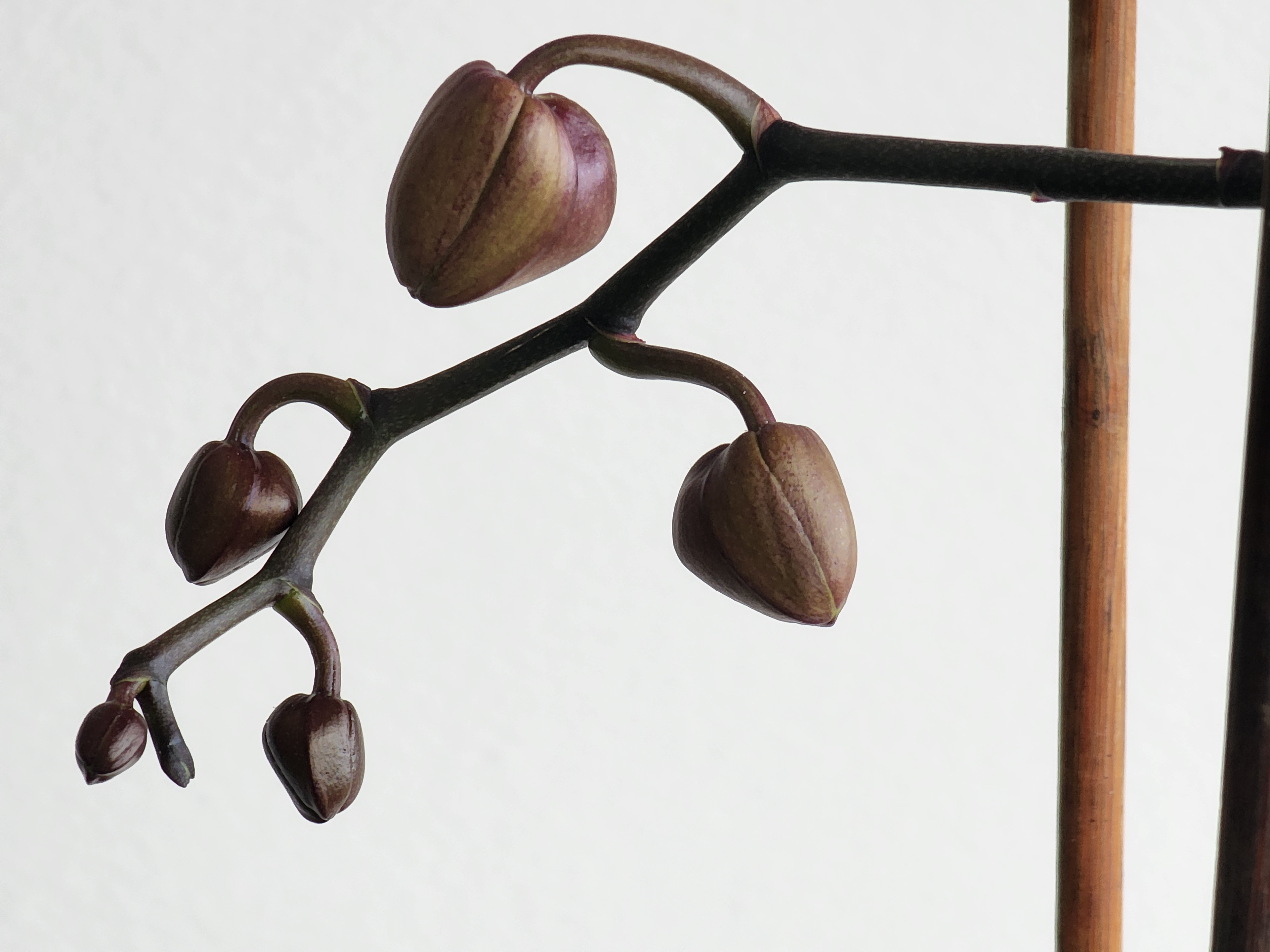
This is also the stage where many growers accidentally cause problems. Once buds reach this size, the orchid has already decided how many flowers it will produce and how they’ll be arranged. From here on, your job is mostly to avoid change. Don’t rotate the plant, don’t move it to a brighter window “just to help,” and don’t start experimenting with watering or feeding schedules. Keep watering consistent, letting the roots approach dryness but not stay dry for long periods, and avoid cold water or temperature drops, especially at night. Fertilizer can be reduced now; heavy feeding won’t improve the flowers and can actually stress the plant if salts build up. The stake in the photo is doing its job, and any further attempt to reshape the spike at this point risks cracking it or forcing buds to twist unnaturally.
As a post, this image works best to explain how much information an orchid gives you before it ever blooms. Bud firmness, spacing, and progression tell you whether your growing conditions were stable weeks ago, not whether you’re doing something right today. If buds abort at this stage, it’s almost always due to sudden changes—drafts, relocation, temperature swings—not because the plant “needed more care.” When an orchid commits to a spike like this, it’s already done the hard work. The most reliable technique now is restraint. Leave it where it is, keep conditions boringly consistent, and let the plant finish what it clearly started.