Why Your Orchid Blooms Are Aging So Fast
Looking at your photo, the first thing that stands out is how vivid and healthy the flowers still look in structure, even as they’re clearly moving past their peak. The petals are a saturated magenta-pink with pale, almost frosted veining that becomes more pronounced toward the edges, and the texture is slightly leathery rather than papery, which tells me the blooms were strong to begin with. The central lips are still intact, and the flowers are evenly spaced along a gently arched spike. Off to the right, the unopened buds are darker, plumper, and matte, hanging like small sealed capsules, which is important. The background window light is soft but cool, filtered through what looks like a screen or sheer curtain, and the city buildings outside are blurred into gray blocks. Overall, this looks like a Phalaenopsis orchid that was photographed just as its flowers started to age rather than one that is collapsing from disease.
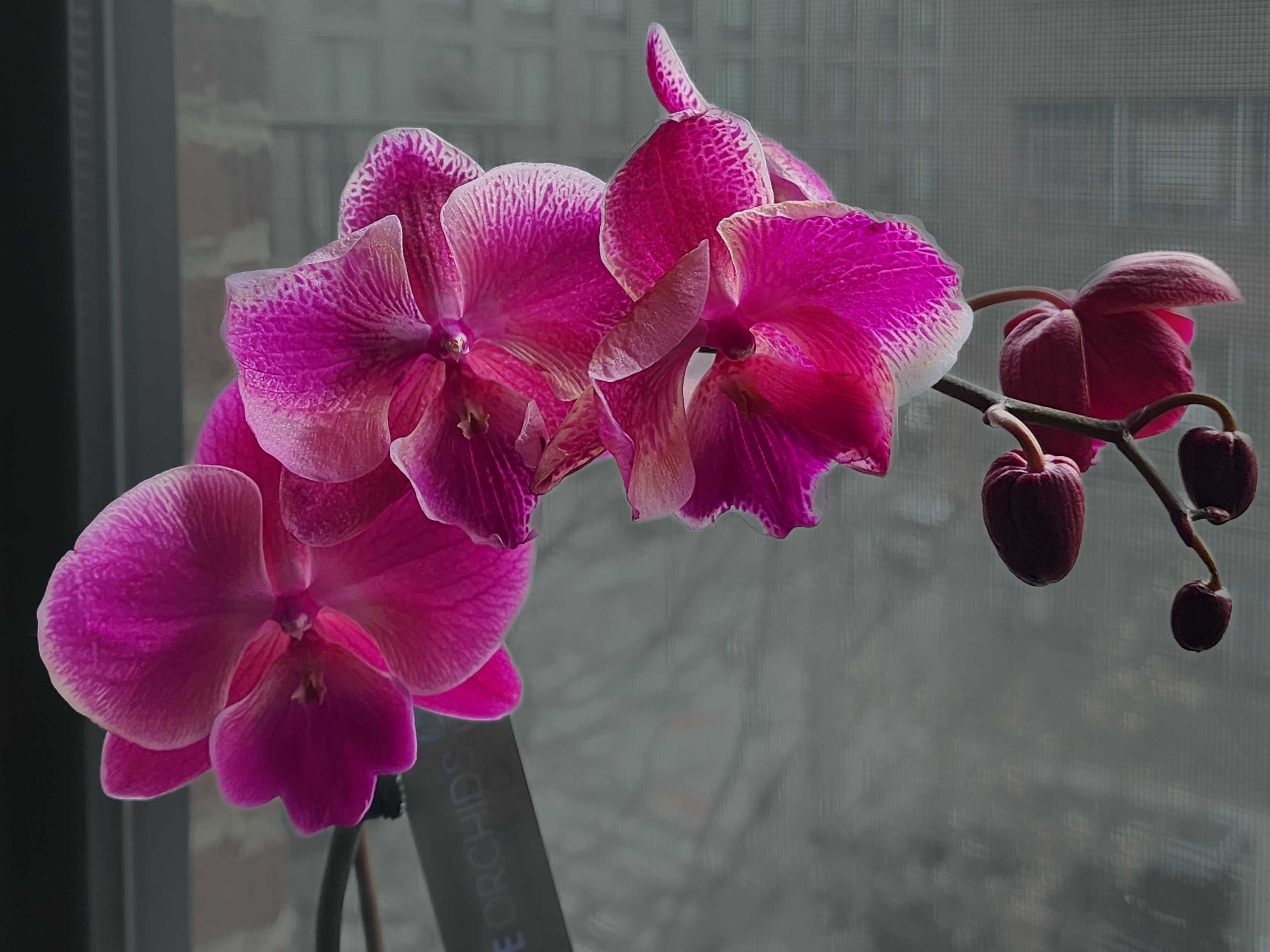
The most common reason orchids seem to “weather” quickly is actually temperature swings, and windows are notorious for this. During the day, especially with winter or early spring light, the glass can heat up just enough to warm the blooms, then drop sharply at night. Orchid flowers are sensitive to these fluctuations, and even a few degrees of repeated change can shorten bloom life. The petals lose turgor faster, colors dull, and edges start to curl inward, giving that tired look even though the plant itself is fine. It’s one of those quiet stresses people don’t notice because the leaves often look perfectly healthy.
Another big factor is ethylene exposure, which sounds technical but is very ordinary. Ripening fruit, especially bananas and apples, releases ethylene gas, and orchids are extremely sensitive to it. If this plant sits in the same room as a fruit bowl, the flowers can age days or even weeks faster than expected. The effect often shows up unevenly, with open flowers fading while unopened buds stall or drop, which fits what I’m seeing here with the buds still present but the open blooms looking past their prime.
Watering habits can also accelerate bloom aging, even when they don’t outright harm the plant. If the roots stay too wet, the orchid prioritizes survival over display, and the flowers are the first thing it lets go of. On the flip side, letting the plant dry out too much can cause subtle dehydration that doesn’t immediately wrinkle the leaves but does shorten flower life. Orchids are annoyingly precise about this balance, and they don’t always give obvious warnings until the flowers start to fade faster than expected.
Light quality plays a role too. Phalaenopsis orchids like bright, indirect light, but direct sun through a window, even for an hour or two, can heat and stress the blooms without burning them. The flowers respond by aging faster rather than scorching, which can be confusing because nothing looks “damaged” in a dramatic way. It’s more like the flowers decide they’re done earlier than planned.
The reassuring part is that fast weathering of blooms doesn’t usually mean the orchid is unhealthy or that you’re doing something fundamentally wrong. Flowers are temporary by design, and even under ideal conditions, a bloom spike has a lifespan. If you move the plant a little farther from the window, keep it away from fruit, maintain consistent watering, and aim for stable room temperatures, the next flowering cycle will almost certainly last longer. Orchids have long memories in their roots and leaves, not in their flowers, and this one still looks like it has plenty of life left in it, just a bit impatient this time around.